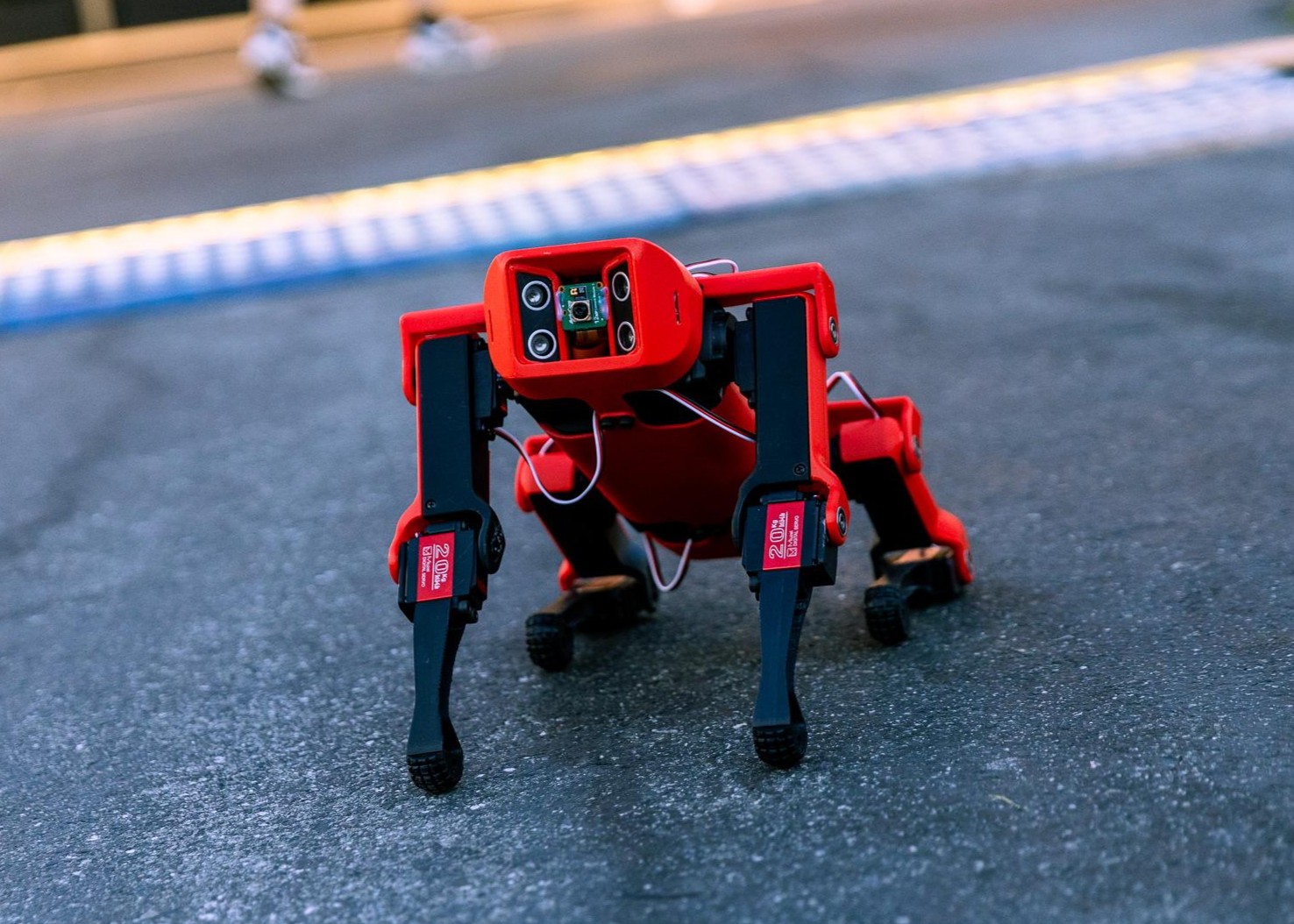
An open-source robotic quadruped that you can use to learn
Making robotics accessible to everyone
Corndog started as a creative solution to a college dilemma. I wanted a drone but they weren't allowed on campus, I decided to build a walking robot instead. What began as an alternative has evolved into a nearly two-year journey of learning robotics, kinematics, and control systems. Based on the open-source MicroSpot project (itself inspired by Boston Dynamics' Spot), Corndog is a small sized quadruped designed with one goal in mind: making robotics (and STEM as a whole) accessible to everyone through open-source design.
Open Source Raspberry Pi 3D Printed Kit Coming Soon
See Corndog in Action
From walking gaits to custom animations, Corndog demonstrates what's possible with accessible open-source robotics.

Swipe to explore different modes and capabilities
Companion Mode
Unique Feature
Attached
Your Robotic Companion
For those long periods of time or distance, Corndog features a special companion mode where it can perch on your shoulder and latch on. This showcases the combination of the inverse kinematics system with traditional motor control and adds a playful, interactive dimension to the robot.
What Corndog Can Do
Movement & Control
- Static Walking Gaits: Stable, controlled movement across flat and angled surfaces
- Standing & Balancing: Maintains stable posture with precise (enough) servo control
- Custom Animations: Pre-programmed emotes and behaviors
- Companion Mode: Can sit on shoulders and stay attached
Technical Highlights
- 12 Servo System: 3 degrees of freedom per leg
- Raspberry Pi Brain: Powerful, flexible (python scripting) control platform
- 3D Printed Body: Accessible, customizable construction
- Inverse Kinematics: Coordinate leg positioning and movement
Technical Specifications
Hardware
Mechanical Design
- Size: Small quadruped (15 inches)
- Actuators: 12 hobby servos (3 per leg)
- Construction: 3D printed components
- Design Origin: Based on MicroSpot open-source project
Electronics
Control & Power
- Main Controller: Raspberry Pi
- Current Power: LiPo battery with buck converter
- Future Power: Custom PCB for 2p2s 18650 battery pack with tethered/free-roaming modes
- Gait System: Currently static walking gaits (with level adjusting)
Software
Algorithms & Control
- Inverse Kinematics: Custom-tuned for precise leg control
- Gait Generation: Static stability algorithms
- Animation System: Custom emote and behavior library
- Planned Features: More dynamic gaits, machine learning, autonomous navigation
The Journey
From College Project to Open-Source Kit
Corndog has been a labor of love spanning nearly two years of development (started in June 2024). As a solo project, it's taught me everything from reverse engineering (the microspot project is in a sorry state) to control theory, from inverse kinematics tuning to power management. The development process has been cyclical, intense bursts of progress during breaks, followed by steady incremental work during the school year.
Biggest Challenges: The inverse kinematics system required a whooooooole lot of fine tuning in order to have the motors activate properly. The software and control systems needed multiple sets of scripts to properly mesh the different systems.
Why "Corndog"? During a brainstorming session with friends, someone suggested "Corndog", and I knew immediately that nothing better would be said. The name stuck, and now it perfectly captures the playful nature of the project.
The robot has even made an appearance during my TEDxCU talk , showcasing the ability to imbue intention into robots.
Open Source & Future Kit
Fully Open Source
Everything that can be made open-source is available on GitHub. The philosophy behind Corndog is simple: robotics should be accessible to everyone who wants to learn, and shouldn't be scary.
- Code: Fully documented and available
- Hardware Files: CAD models, STLs, BOMs
- Software Build Instructions: Mostly complete
- Hardware Build Guide: Assembly Guide available
Upcoming Kit
A comprehensive kit is in development that will make building your own Corndog easier than ever. The goal is to achieve "Prusa level" documentation quality, with everything you need to succeed.
- Multiple Tiers: Different purchase levels for various budgets
- Complete Documentation: Step-by-step build guide
- All Components Included: No hunting for parts
- Learning Focus: Understand robotics while you build
Kit launch planned alongside comprehensive YouTube video (coming in 1-2 months)
Video Documentation
Comprehensive Video Coming Soon
Detailed build tutorials, demonstration videos, and technical deep-dives are currently in production. Subscribe to the OpenLoneHollow YouTube channel to be notified when they go live!
What's Next
Corndog's development continues with several exciting improvements planned:

Priority 1: Custom PCB
Dedicated power management system with 2p2s 18650 battery pack, integrated charging, and tethered/free-roaming capability. This will replace the current makeshift LiPo setup.

Priority 2: Autonomous Navigation
Adding sensors and algorithms for obstacle detection, path planning, and autonomous movement. Making Corndog truly independent.

Priority 3: Kit Development
Finalizing the comprehensive kit with multiple purchase tiers, complete documentation, and tutorial videos. Making Corndog accessible to everyone.

Priority 4: Dynamic Gaits & ML
Implementing dynamic walking algorithms and exploring machine learning for adaptive movement. Taking Corndog's capabilities to the next level.
Get Involved
Corndog is more than just a robot. It's a community-driven project aimed at making robotics education accessible. Here's how you can get involved:
Star on GitHub
Check out the code, documentation, and hardware files. Contribute improvements or fork it for your own project.
Subscribe for Updates
Follow the YouTube channel for upcoming tutorial videos and project updates.
Support Development
Help support continued development and the creation of comprehensive tutorials.